
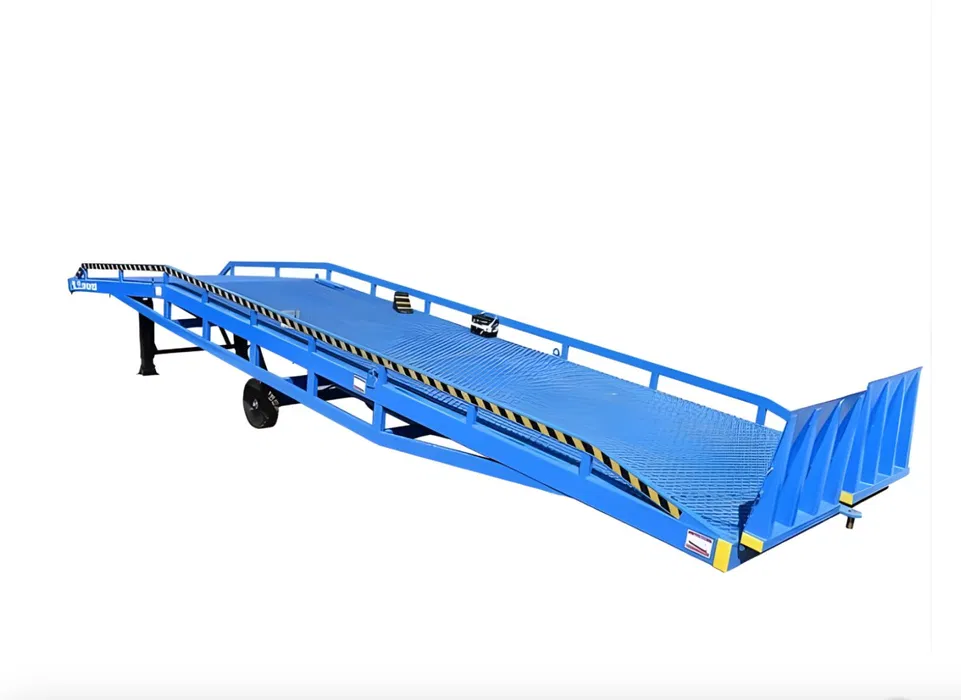
A loading ramp is a practical solution that makes loading and unloading goods between a lorry and a warehouse or handling equipment much easier. It is used in manufacturing plants, logistics centres, warehouses, distribution sites and agriculture, where it helps speed up material handling while improving workplace safety. In many operations, a well-chosen loading ramp can cut loading time by tens of per cent and reduce equipment downtime.
Loading ramp
Where a fixed loading dock cannot be built, the ideal solution is a lorry loading ramp that can be moved exactly where it is needed. Mobile solutions allow various types of lorries to be served without costly construction work, and are suitable for forklifts and other handling equipment. Modern loading ramps are designed to handle everyday loading, withstand the weather and ensure a stable crossing even when handling heavy loads on pallets. When choosing, it is therefore important to focus not only on load capacity but also on dimensions, the quality of the steel structure, the anti-slip surface and the height adjustment options.
Choose a quality loading ramp
A correctly chosen loading ramp can significantly speed up the handling of goods, reduce downtime and increase work safety. When choosing, it therefore pays to look not only at the price, but above all at the load capacity, dimensions, quality of the steel structure and the height adjustment method.
If a truck loading ramp is to be used every day, it should easily cope with repeated loading by forklifts and heavy loads. An anti-slip surface, safety barriers, quality approach plates and stable anchoring during loading are also important. Modern loading ramps allow the servicing of various types of trucks, increasing the flexibility of the whole operation.
A mobile truck loading ramp is useful wherever there is no fixed loading dock or the loading location changes frequently. It is used by manufacturing companies, logistics centres, warehouses, construction companies and agricultural operations.
If you plan to expand your storage or production space, it pays to think about handling comprehensively. A loading ramp is the ideal addition to shipping containers, storage areas and modern tent halls, where it allows quick and safe loading and unloading of goods without costly construction work. Logistics thus remain smooth even in seasonal or temporary operations.
Loading ramp: what are its advantages?
A correctly chosen loading ramp makes the handling of goods more efficient, shortens loading time and increases safety at work. It is appreciated by companies that work with forklifts every day, supply warehouses or dispatch goods on wooden euro pallets. To get the maximum benefit, however, it is important to choose a solution that matches the specific conditions of the operation.
Main advantages of a loading ramp
A quality truck loading ramp brings many practical advantages that show in daily operation.
significantly speeds up the loading and unloading of goods,
allows forklifts to pass safely between the warehouse and the truck,
reduces the physical strain on workers and minimises the risk of damage to goods,
is suitable for handling goods stored on wooden euro pallets and other pallet systems,
quality loading ramps can easily be relocated according to the current needs of the operation,
they are a more cost-effective solution than building a fixed loading dock.
Another great advantage is the easier connection of the individual parts of the warehouse. A loading ramp complements equipment such as pallet racks, cantilever racks or outdoor storage areas perfectly, ensuring a smooth flow of materials from receipt to dispatch.
What to consider before buying?
Even the best truck loading ramp will only work reliably if it is correctly chosen for the specific operation. Before buying, we recommend focusing mainly on the load capacity, dimensions, maximum height of the vehicles served and the type of handling equipment.
A quality anti-slip surface and a stable base are also important. If the ramp is used on unpaved areas, recycled plastic flooring can be a suitable solution, helping to create a firm, level base for safe handling. Correctly designed loading ramps then ensure trouble-free operation for many years, even with intensive daily use.
Truck loading ramps: their use in practice
Logistics centres, warehouses and production
For daily dispatch of goods, a loading ramp is an essential part of modern logistics centres, warehouses and manufacturing companies. It allows quick handling of palletised goods, easy supply of storage areas and efficient servicing of racks with forklifts. A quality truck loading ramp helps speed up loading and unloading and reduces downtime during dispatch.
Construction and industry
On construction sites and in production plants, loading ramps are used to handle building materials, steel structures, machinery and bulky loads. A truck loading ramp makes it easier to move heavy loads safely even where there is no fixed loading dock.
Agriculture and storage
A loading ramp is also useful in agriculture. It makes it easier to load feed, seed, hay bales and farm machinery, while making the supply of buildings such as livestock shelters, stores or container shelters more efficient. A mobile truck loading ramp is also a suitable solution for seasonal operations.
Shipping containers and tent halls
Modern loading ramps are often used for loading and unloading goods into shipping containers, mobile stores or production areas. They are also an excellent addition to tent halls, where they allow forklifts to pass safely and materials to be handled smoothly without building a fixed loading dock. As storage capacity grows, a truck loading ramp is a simple way to increase the efficiency of the whole logistics operation.
Why choose loading ramps from Hagro?
The right loading ramp is an investment that pays for itself quickly with regular handling of goods. In the Hagro e-shop you will find quality loading ramps designed for daily professional use in warehouses, logistics centres, manufacturing companies, construction and agriculture. Every truck loading ramp is designed with an emphasis on high load capacity, stability, safe passage of forklifts and a long service life even in intensive operation.
Besides mobile ramps, we also offer complete solutions for storage and logistics. Our range includes shipping containers, gable and arched halls and other useful accessories for your project. This means you can equip your entire storage or production site in one place.
If you are not sure what to choose, we will gladly help you select a truck loading ramp according to load capacity, dimensions, type of handling equipment and the nature of your operation. Our aim is to deliver a solution that will serve reliably for many years and contribute to faster, safer and more efficient handling of goods.
Foire aux questions
Une rampe de chargement doit être dimensionnée pour supporter le poids du chariot élévateur ainsi que celui de la charge transportée. Les rampes de chargement standard ont des capacités allant de quelques tonnes à plusieurs dizaines de tonnes ; il est donc toujours important de fonder votre choix sur les conditions réelles d'exploitation et de prévoir une marge de sécurité pour l'avenir.
Si le chargement s'effectue à plusieurs endroits ou si aucun quai de chargement fixe n'est disponible, une rampe de chargement mobile pour camions constitue la solution idéale. Elle permet une manutention rapide sans travaux de construction et peut facilement être déplacée vers un autre emplacement si nécessaire.
Dans la plupart des cas, oui. Les facteurs déterminants sont la capacité de charge de la rampe, sa largeur, sa pente et sa surface antidérapante. Une rampe de chargement pour camions bien conçue permet un passage en toute sécurité tant pour les chariots élévateurs électriques que pour ceux fonctionnant au diesel.
Elle est le plus souvent utilisée pour la manutention de marchandises stockées sur des palettes en bois, le transport de matériaux de construction, de machines ou de produits volumineux. Dans l’industrie, les rampes de chargement sont également souvent utilisées pour déplacer des blocs de béton de type LEGO, des structures en acier ou des marchandises destinées à être stockées dans des rayonnages à palettes.
Une rampe de chargement de qualité ne nécessite pas d’entretien particulier. Nous vous recommandons de vérifier régulièrement le mécanisme de roulement, les soudures et le système hydraulique (si la rampe en est équipée), ainsi que de maintenir la surface antidérapante propre afin de garantir une utilisation en toute sécurité tout au long de l’année.